Chicken stampede: Who knew? May 17, 2013 11 Comments
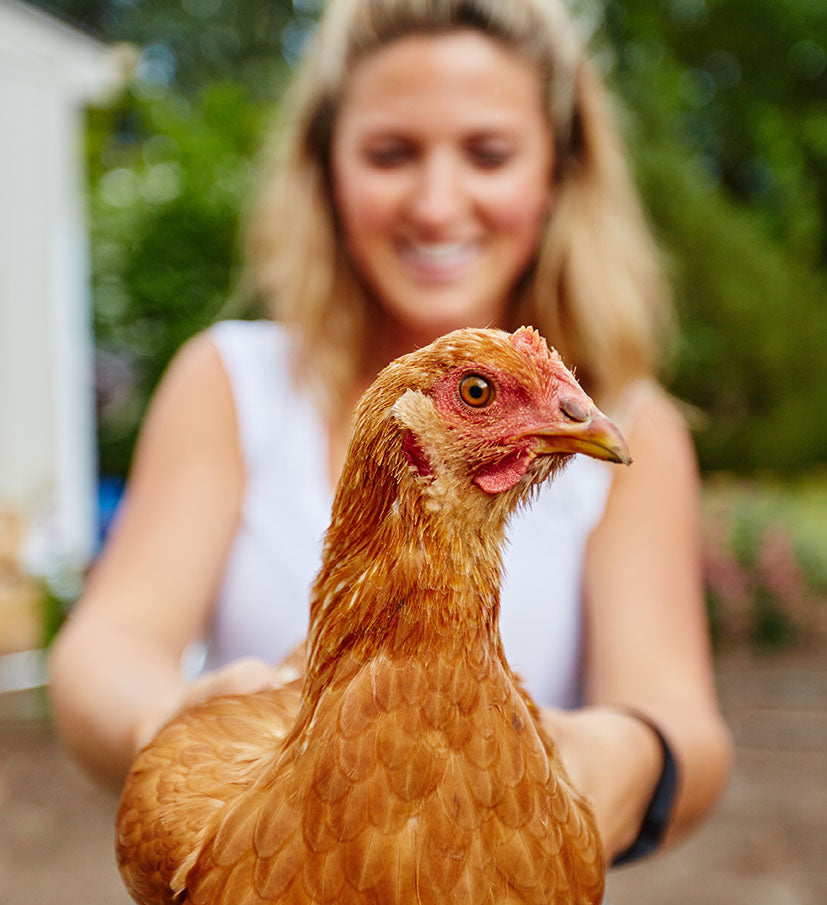
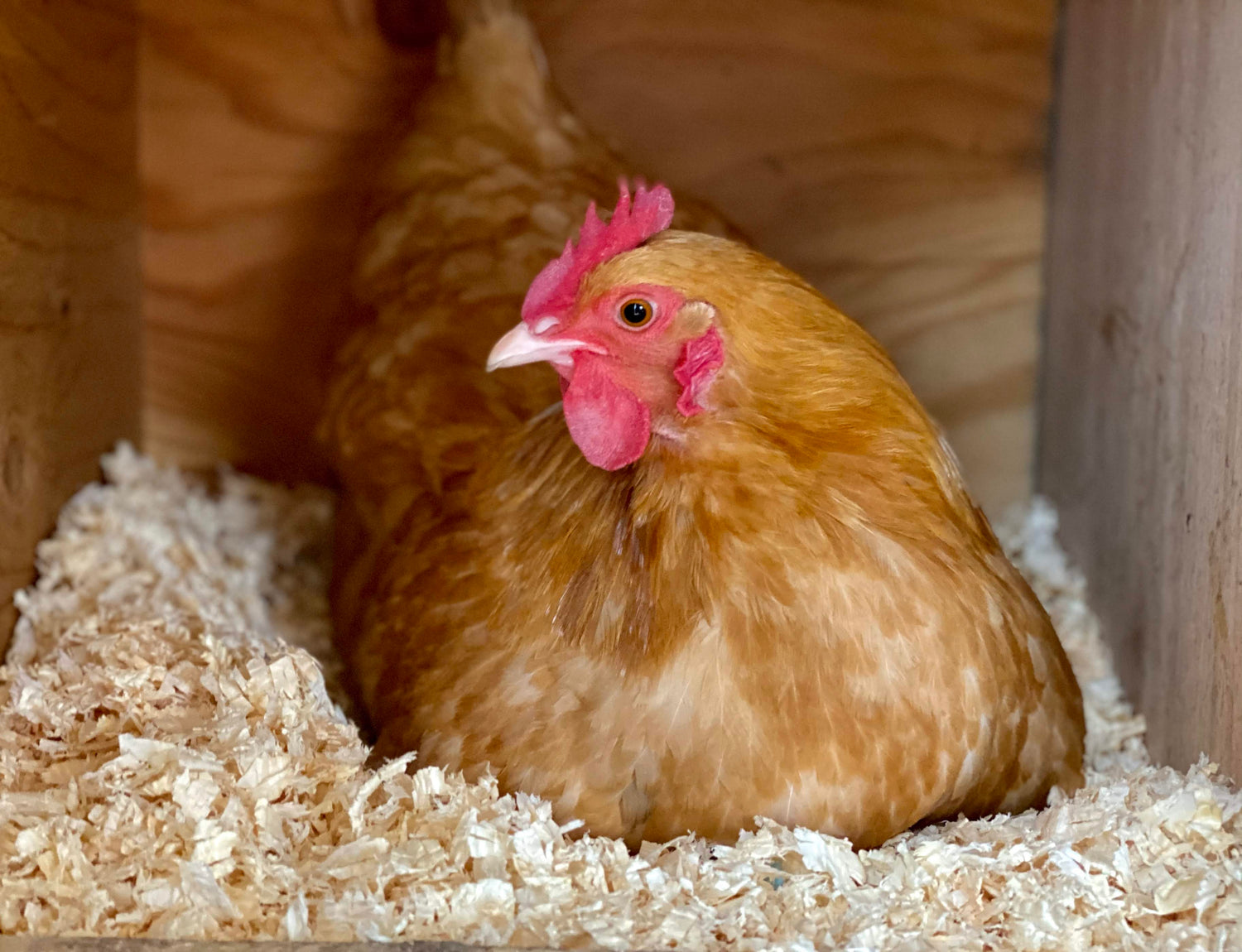
Before I got chickens, I pictured them as rather easily spooked, nervous, flighty. But nothing seems further from the truth. When I walk outside, they don’t scatter and run away. Instead, I am the target of a chicken stampede. If you keep chickens, you know what I mean. Wherever they are in the yard, they come running and flapping toward me—just in case I might have a treat hidden somewhere on my person. Some don’t care about treats as much as they just want some petting and attention.
I’m sure this has partially to do with the breeds I have in my flock. I don’t tend to choose breeds known for flightiness; I want a calm flock. I have Welsummers, Speckled Sussex, Favaucanas, Faverolles, Ameraucanas, Easter Eggers, Brahmas, Rhode Island Reds and more. They all tend to be friendly. But I really didn’t think it would be that easy to have a tame flock. Little did I realize!
What boggles my mind about the chicken stampede even more is that they really don’t seem to be dissuaded by anything, even the lawnmower. My cats are deathly afraid of the vacuum cleaner. But my chickens aren’t chicken at all. In fact, if I try to run the shop vac outside, it can be a challenge to clear a space to use it. I’m afraid I’m going to accidentally suck up feathers, because they give me no space.
Shop vac, air pump, car, tractor, mower: nothing really phases them. In fact, when I’m mowing the lawn, they’re more likely than not to chicken stampede the mower, looking for stunned bugs. At times, while I’m mowing, it looks as if I’m the lead vehicle in a chicken parade: they follow in an unruly group line behind me. I should deck the John Deere out as a float, and follow up with a marching band; we’d totally be set!
I’m just curious: are your chickens brave or fearful? Are they afraid of your mower, or do you—like me—get a chicken stampede every time?
What to tell your chicken sitter May 10, 2013 11 Comments
I wrote a post a while ago, entitled “three ways chickens will freak you out.” A recent comment by a reader reminded me of another way chickens can freak you out, and it inspired me to share the story of how I almost gave our chicken sitter a heart attack!
Poor John. He didn’t take his “chicken sitter” duties lightly, and we’re glad of that! But he did spend a few restless nights because I neglected to warn him about something.
Adult chickens just don’t need a lot of supervision. A chicken sitter is a luxury, really. You can leave them for a few days, provided they have plenty of food and water, and access to the outdoors so they don’t get bored (or overheated in a closed coop!).
Even so, when we’re gone, we like to have someone who will check on them just to make sure they don’t knock over their waterers, for example. We just want to make sure someone is around in case we should have an injury; just for emergencies, really. However, we live far enough out in the country that we don’t have neighbors close enough to just pop over and take a look… and we also live far enough out in the country that it’s something of a vacation for our in-town friends to spend a weekend out here with a big porch, many porch swings, and nothing but a view of the West Virginia mountains around them. We like to have a chicken sitter. Read the rest of this entry »
Simple Hollandaise Sauce May 7, 2013 3 Comments
Oh the French… they have some of the most wonderful sauces I have ever tasted, and yet they’re often quite complicated to make. Hollandaise sauce is among my favorites, but my schedule and lack of patience had me turning to the grocery store packet mix when I have a craving for eggs Benedict. I hated that! I needed to create a simple Hollandaise sauce recipe.
Each spring when the asparagus in the garden starts to emerge, and the chickens are laying eggs in abundance, I crave the from scratch version. With my handy food processor (or a blender) I’ve come to a better, quicker solution, a simple Hollandaise sauce. So, no more powdered packets for us!
It’s so easy, and tastes exactly like the classic sauce to a T. Here’s my recipe for Simple Hollandaise Sauce.
Simple Hollandaise Sauce
- 3 egg yolks
- 1/4 tsp Dijon Mustard
- 1 Tbsp lemon Juice
- 1 pinch of cayenne pepper
- 1/2 cup melted butter
Add your yolks, mustard, lemon juice and pepper right into the blender or food processor container. Pulse on high for 5-10 seconds. Then with a slow steady stream, pour in the still-hot butter until completely combined. If your sauce is a little thick for your taste, whisk in a tablespoon of warm water to thin it out. That’s all there is to it!
Serve your simple Hollandaise sauce immediately or keep it warm in a double boiler until ready to serve.
According to Julia Child, “Sauces are the splendor and the glory of French cooking.” I agree! Do you have a favorite sauce you use your spring abundance of eggs to make? If not, what do you like to do with eggs when you’re overrun?
Keep your chickens from scattering the mulch May 3, 2013 12 Comments
My chickens free range, and there are a lot of benefits that go along with that. I love to garden… and there are a lot of benefits that go along with that, too. Sometimes these two hobbies are tough to combine though. Chickens love to scratch. They love to dig. They love to dust bathe. And none of this is particularly good for your garden. They’ll eat your newly planted seedlings just as fast as they will eat weeds and bugs. And even when they’re not eating your plants, they’re wallowing holes in the ground to dust bathe. They won’t care if they’ve just crushed all your petunias and scattered 20 cubic feet of mulch that you spent four hours laying down. So, if you’re like me, you might struggle to keep your garden beds free of chicken damage. Especially difficult is figuring out a way to keep your chickens from scattering the mulch out of your landscaping beds.
First I’ll share a couple of the traditional solutions to managing the damage chickens can cause to your gardens and landscaping, then I’ll tell you my secret way to keep your chickens from scattering the mulch in your beds. Read the rest of this entry »
Gardening For Your Chickens April 30, 2013 7 Comments
As a gardener I want my entire family to benefit from what we grow. That includes the chickens and ducks. Fresh foods are important to the health of our chickens; healthier chickens means healthier eggs. When choosing our seeds to plant for the year, we keep the chickens and their needs in mind. You may want to try gardening for your chickens, too!

Spring Garden Beds – When you garden for your chickens, you can start early! We’re already growing greens to share with the chickens.
Of course, you can’t let the birds wonder freely in the gardening. It’s a wonderful notion to think your chickens are out in the garden eating bugs and fertilizing as they go. The reality is they’re going taste test something off of every plant leaving you with ripped lettuce leaves and holey tomatoes. Read the rest of this entry »
Vintage Trailer Coop April 26, 2013 2 Comments
Glamping: have you heard of it? It’s “glamorous camping.” Glamping in Vintage Trailers is now A Thing. In fact, not too long ago, I got an old vintage Shasta that I plan to restore. West Virginia is a fabulous place for camping, and a vintage trailer to glamp with is just what I needed! I might serve up martinis or Tiki beverages with little umbrellas (or our home brewed beer). There will be tablecloths and cute dishes, and I’ll get to sleep on a bed. (I’m getting too old for tent camping!) But what does this have to do with chickens, you might ask? Nothing, really… except that a visionary has somehow combined two of my loves and built this adorable vintage trailer coop.

He’s named his vintage trailer coop “Ham-N-Eggs,” referring to the “canned ham” shape of the old trailers.
It’s even a Shasta. Read the rest of this entry »
Grocery store egg labels: what they REALLY mean April 25, 2013 4 Comments
Here’s an article I recently wrote about grocery store egg labels for dLife, a wonderful online resource for folks with diabetes. Many chicken-keepers are already aware of the difference “cage-free” and conventional eggs—and that’s part of the motivation for keeping chickens. For you who aren’t aware, this one’s for you.
Checking out the egg case can be an overwhelming experience. There are so many egg labels slapped onto egg cartons these days, and many are not what they seem! Here we demystify those egg labels:
Conventional – Conventional eggs are those that are not labeled Cage-free, Free-Range or Organic. Read the rest of this entry »
The Hot Tomato vs. the Aggressive Rooster April 19, 2013 8 Comments
My friend Jesse, owner/instructor at the Hot Tomato Pinup Academy, recently shared a story with me about a battle she once had with an aggressive rooster belonging to her family. This is one reason I love my job so much: I get to hear the best, most entertaining stories about chickens, not to mention that my farm will be a site for an upcoming Hot Tomato photo shoot! Picture Jesse doing battle with a rooster:
She’s definitely got the girl power and the force of personality to back her up. Plus, her story was so charming that I just had to share it with you.
The Hot Tomato Vs. the Aggressive Rooster
The kids and I went to feed the chickens that morning and saw, for the first time ever, that Condor the rooster was not his usual charming self! He had gotten out of his pen that morning, but we were assured that he was “real tame” and “wouldn’t bother us” when we went to feed the chickens. Little did we realize!
The driveway is about 250 ft long and Condor was crowing his head off the whole time we were walking toward the house. At first we thought, “Oh, how sweet! Condor is happy that we are coming to see him.
Ha!
Have you ever seen a mad rooster? Read the rest of this entry »
DIY roll-away nest box April 16, 2013 4 Comments
We have had mixed success with our egg-eating hen Isa that I talked about in this blog post. I appreciated all the feedback and suggestions you offered on that post—it’s good to know that I’m not the only one dealing with this problem! I tried one of your suggestions, and I also went ahead with my plans to create a simple DIY roll-away nest box.
I looked at a number of designs and worked out a plan for a DIY roll-away nest box using the materials I had in the garage to work with: plastic cat litter buckets. Isa was still in her temporary coop in our garage, and the nesting box she had been using is a modified bucket that we access from the front. I wanted to make sure the new DIY roll-away nest would be something she’d recognize as a nest box.
My plan was to make the nesting box so that it tilted forward, with a compartment in the front to catch the egg. I lined it with plastic door mat material so the egg would roll, but it would still be cushioned from breakage. Into the coop went the new nest box for testing.
The next morning Isa’s egg was in the compartment waiting for me: success! And that success continued. The only morning I found a broken egg was when one of the zip ties broke—it had been holding the egg door. I fixed that problem, washed the egg yolk out of the doormat, and the next morning it worked perfectly again. Feeling that we had fixed the problem, I was ready to move her out to the real coop with her sisters. Read the rest of this entry »
Hildy the blind hen learns to forage April 5, 2013 5 Comments
If you haven’t read the previous stories about Hildy, let me introduce her to you. She was our blind hen, and one of our favorites. She lost her sight when she was young, and had only very limited vision throughout the rest of her life. From what we could tell, she seemed to be able to distinguish light and dark, at least to a certain extent. If you haven’t already, you can read the earlier Hildy stories in the blog about how our blind hen Hildy learned to adapt to life in the flock.
When she learned to come out of the coop, though, we worried, because unlike the other hens, she couldn’t see to forage… and she never did learn to go back in the coop on her own. That meant that when she came outside, she went without food, because she couldn’t go back inside to get to the feeders she was familiar with. And she just didn’t understand that food was all around her.
You’ll remember from my last story that with a lot of work and effort we were able to teach our blind hen to eat treats from our hands—but it didn’t solve the problem, which which was that if she was outside, she couldn’t forage to eat when she got hungry. Instead, she had to wait for us to come outside and feed her. It just wasn’t ideal, and we needed a solution. Read the rest of this entry »